When the Storm Passed, the Circle Remained
Cyclone Ditwah and the Living Practice of Play for Peace in Sri Lanka
On the night of the 27th, Sri Lanka went to sleep expecting rain and woke up to devastation.
Cyclone Ditwah tore through hills and villages, triggering landslides that swallowed homes, silenced families, and reshaped entire communities. By morning, more than 600 lives had been lost. Over a thousand safety centers emerged almost overnight. Fear, shock, and stillness settled into bodies before words could.
In moments like these, people freeze.
Not because they don’t care—but because grief arrives faster than language.

The First Response: Survival Before Sense-Making
In the days immediately following the cyclone, the response was practical and urgent. Communities mobilized to ensure food, shelter, and safety. A community kitchen was set up at the Divisional Hospital in Muruthalawa, serving hundreds of meals over four days. Volunteers worked long hours, hands moving even when hearts were heavy.
Yet beneath the logistics, another reality was quietly unfolding.
Children—nearly 100,000 of them across affected areas—were absorbing the shock in their bodies. Many had lost siblings, neighbors, routines, and the sense that the world was predictable. Adults were busy surviving. Children were silently learning new lessons: be still, don’t ask, don’t feel too much.
When Play Entered the Camps

On December 3rd, Sinthuja Shanmuganathan (Global Team Member & Play for Peace Facilitator in Sri Lanka) visited one of the most affected communities in Cross Junction village in the Nillambe area of Kandy District. Two safety centers housed 46 families and 165 people, including 25 children. Thirteen lives from that single community had been lost.
Among the children was a small girl who held her father tightly, her body rigid, her eyes far away. We later learned she had lost both her brothers—aged 13 and 16. There was nothing to say. Then the very next day Sinthuja togther with Maria Losket (Global Council Leader from Warsaw, Poland) again the next day—not with answers, but with play.
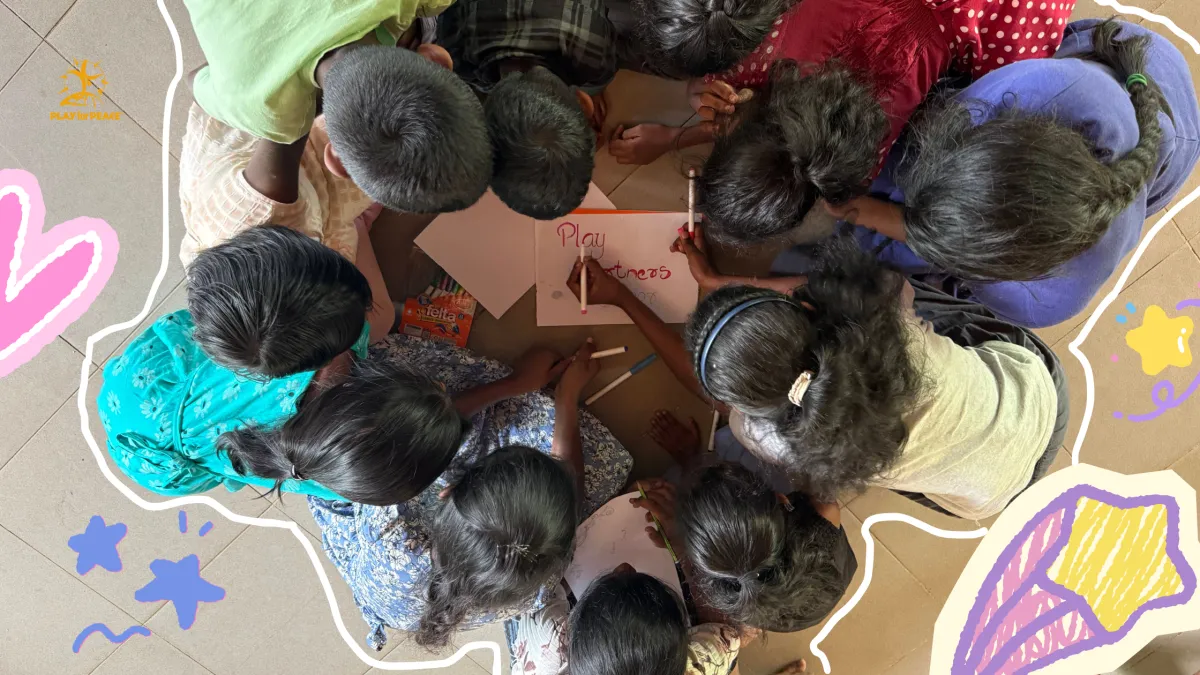
We gathered the children in the middle of the relief center, while adults lay nearby, bodies curled inward from exhaustion and grief. Slowly, gently, we began. Simple games. Familiar rhythms. No pressure to perform. No demand to be okay.
And then something shifted.
Laughter surfaced—hesitant at first, then fuller. Bodies opened. Elders smiled. The atmosphere softened, as if the community itself exhaled for the first time since the storm.
The little girl who lost her brothers stayed outside the circle for a long while, watching. We invited her only to feel safe nearby. After several activities, she stepped closer. Later, she entered the circle. During a “Magic Marker” activity, she stood in the center and led others through movement and imagination. She laughed. She played. Later, during storytelling, words poured out of her—fast, urgent, alive.
In that moment, play restored something the cyclone had taken: agency.
Practice Peace Becomes a Holding Space
As weeks passed, Practice Peace sessions continued. By December 27th—exactly one month after the disaster—the fourth session coincided with a community commemoration for the lives lost.
What happened that day could not have been planned.
As the interfaith ritual unfolded, children slowly moved away from their parents and gathered around the Play for Peace volunteers. No instructions were given. No games were initiated. They simply came and stood close.
In silence, in tears, in stillness—Play for Peace stopped being a session and became a holding space.
Adults wept. The children stayed. The circle held grief, memory, laughter, and dignity all at once. It was a reminder that peace is not the absence of pain—but the presence of connection within it.

From Sessions to Community Healing Corners
By the second Practice Peace session in Kandy District, something new emerged. Children began shaping the space themselves. Together with PFP faciliators, the chidlren co-created Community Healing Corners—places rooted in play, safety, and belonging.
They named them:
Play Partners’ Corner
Play Fire Stars Club
These were not symbolic names. They were declarations of ownership.
Children facilitated activities. They invited others. They painted, wrote, played drama, and ran their own sessions. Within a single week, children independently led 17 practice sessions.
What began as support was now becoming community capacity.
A Movement Grows
By 24th January 2026, seven Practice Peace sessions had been conducted across cyclone-affected communities. What started with the presence of two global members of Play for Peace had organically grown into a 17-member volunteer movement.
More than 20 volunteers completed online training. Ten began coordinating field sessions. This was no longer a short-term response. It was becoming a process—rooted in consistency, care, and shared responsibility.
Volunteers did not arrive as helpers alone. They arrived as learners, facilitators, and companions. Children were no longer passive recipients of aid. They were co-creators of healing.
Local Attention and Collective Trust

As the initiative unfolded, it began to draw attention beyond the immediate communities. Local government officials and civil society actors visited sessions, observed the Community Healing Corners, and engaged in dialogue around child-centered psychosocial recovery.
What stood out to them was not only the methodology, but the response of children:
their willingness to gather, their ease around facilitators, and their ownership of the spaces created.
Play had quietly built trust—the kind that institutions often struggle to establish in the aftermath of crisis.
From Relief to a One-Year Journey
What we began as an emergency response continued for seven weeks, teaching us something essential: healing cannot be rushed.
With this learning, the initiative is now transitioning from response to process. Beginning in March, this work will expand into a one-year, community-rooted project, designed to accompany children and families through sustained recovery, resilience-building, and leadership through play.
The storm may have passed—but its impact remains. So does the circle.

What Remains After the Storm
Cyclone Ditwah changed the landscape of Sri Lanka—but it also revealed something enduring.
When systems are overwhelmed and words fall short, play becomes a language of survival and dignity. Circles become anchors. Laughter becomes resistance. Presence becomes medicine.
The Play for Peace community did not bring peace to these communities.
It helped uncover the peace that was already waiting—to be remembered, practiced, and shared.
And long after the storm passed, the circle remained.