
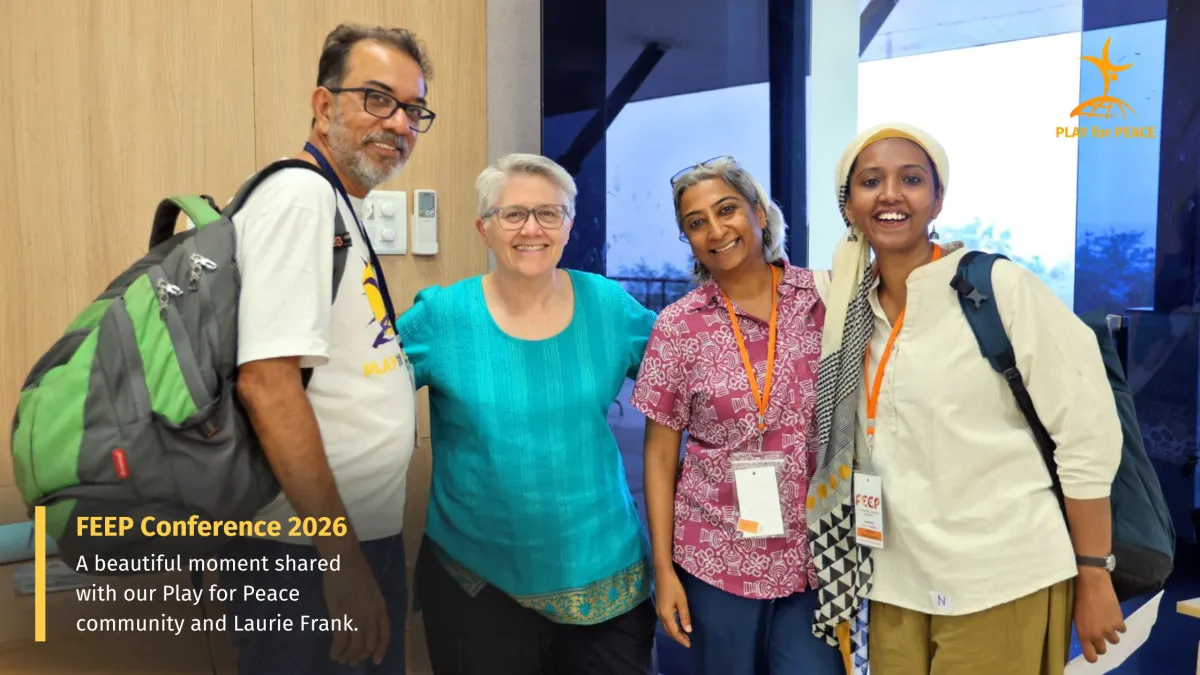
Play for Peace joined the FEEP Conference in India — a space of resistance, experiential wisdom, and deep community across cultures and borders.
A Journey of Community, Resistance, and Experiential Wisdom
In 2025, during my field visit to India, I met Vishwas Parchure, a passionate igniter of experiential educators across India. That meeting was not accidental — it was the beginning of a journey.Seated with Vishwas, Swati and Agyat in conversations filled with questions, reflections, and learning movements, I felt a deep sense of connection to the experiential education community.
Soon after, an opportunity emerged. I was invited by Swati and Agyat to co-work on a proposal to offer a 180-minute workshop at the FEEP (Foundation for Experiential Education & Practices) Conference. And so began a journey — representing Play for Peace®, alongside our ambassadors and extraordinary trainers, Swati and Agyat.
The intention and invitation of Vishwas stood through strong in this journey !
Landing Into Community
Landing in India, I went straight to embrace Swati and Agyat. From there, we rushed to meet Laurie Frank.
Until that moment, everything felt sequenced. Planned. Linear.
But after meeting Laurie, something shifted.
What unfolded was not sequential — it was transformational.
Through her presence and process, my understanding of Play for Peace deepened — theoretically, practically, and in research-grounded ways. I began to see more clearly how Play for Peace stands as a unique and powerful methodology within experiential education.
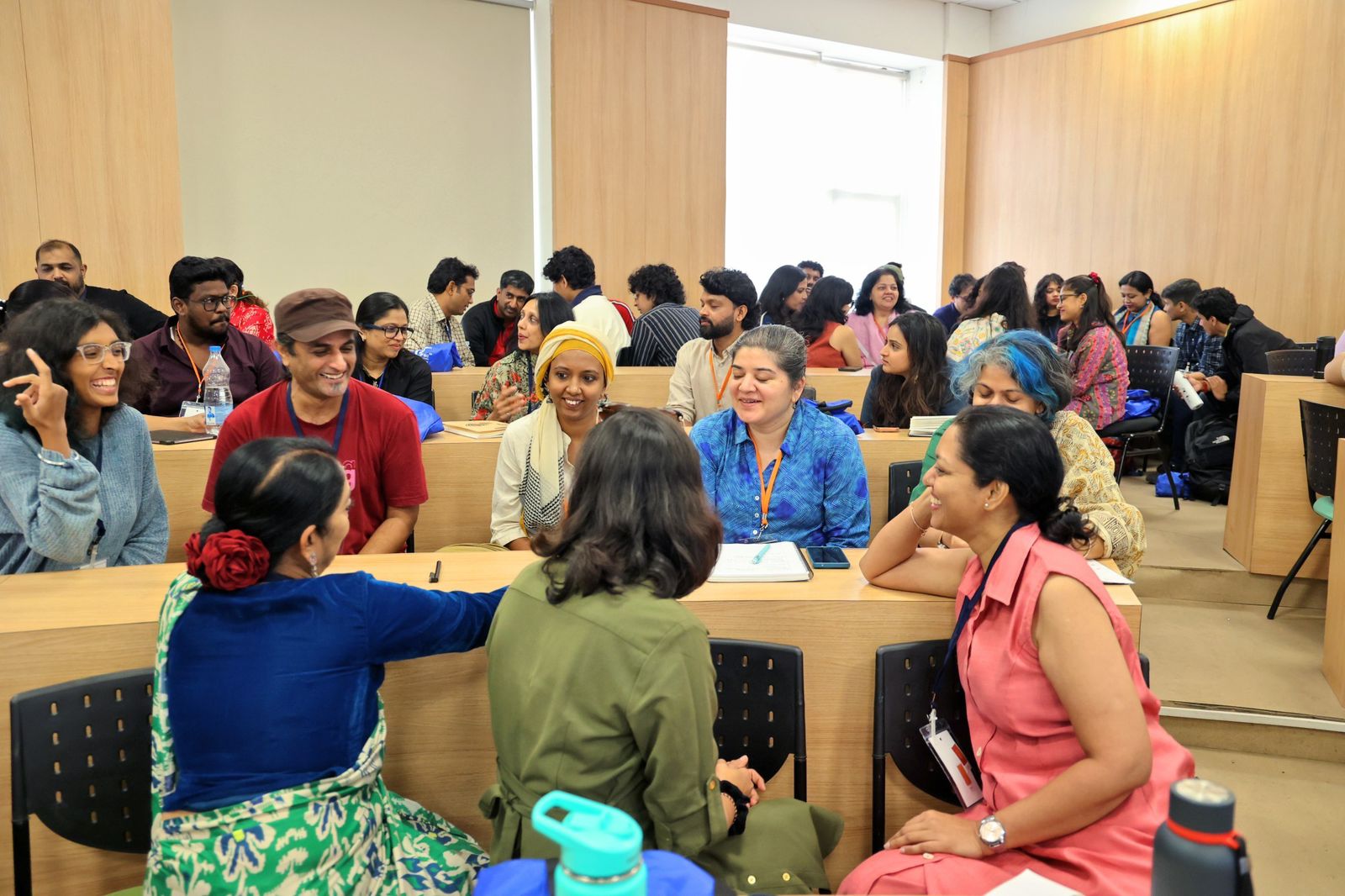
Master Class I: Creating Community with Intention
To sit with Laurie Frank — author of The Caring Classroom — was to enter a living classroom of embodied wisdom.
This master class was not just a session.
It was an enlightening space. A path.
To meet.
To listen.
To be.
To experience.
To move.
To reflect.
To learn.
To contemplate.
Participating in this session felt like returning to where I began — yet seeing it for the first time. I realized deeply that community does not happen by accident; it requires intentionality. It requires clarity of vision (why we gather), mission (what we stand for), and framework (how we nurture it). The idea of the “container” stayed with me — that the emotional and relational environment determines everything. Growth becomes possible only when people feel safe enough to risk, supported enough to persist, challenged enough to change, and connected enough to care.
I understood that activities alone do not create impact. It is the facilitator’s intentional presence, the agreements we co-create, and the environment we consciously design that shape transformation. Community is not a concept to discuss — it is a responsibility to embody.
In Laurie’s presence, the community became a lived concept .
And I left feeling expanded, grounded, and deeply humbled.
Master Class II: Thinking Experientially
What does it mean to think experientially?
Laurie gently divided the question open — and instead of offering definitions, she offered experience.
Though the title spoke of “thinking,” what we encountered was feeling, sensing, perceiving — and then transcending.
In a matter of microseconds, she guided us through the experiential learning cycle — experiencing, reflecting, thinking, and acting — and suddenly everything connected. Without reflection, experience becomes scattered. Without intentional design, learning becomes accidental. We arrived at the very place we began — yet saw it differently.
“Ohhh… I see it now.”
That was the collective realization.
I gained clarity that experiential learning is the human learning process — how we naturally learn through direct experience and reflection — while experiential education is the intentional practice of designing environments that support that process. It is not about adding activities; it is about cultivating awareness, relationships, and meaning. Experiential thinking asks: Why does this matter? What is happening? How does it work? What if we try differently?
I felt both humbled and expanded — as a learner and as a facilitator. I walked away knowing that experiential education is not merely methodology; it is relational, embodied, reflective, and deeply intentional work.
A teacher — truly — in the deepest sense.
Co-Working With Comrades: Play as Resistance
One of the most outstanding moments of the FEEB journey was co-designing and co-facilitating the Play for Peace session titled “Play as Resistance.”
To sit with the legendary experience of Swati and Agyat and decode the impact of play as a political, relational, and healing force was joyful and critical at once.
Together we explored:
How play challenges oppressive systems
How safe spaces can become spaces of resistance
How experiential processes open dialogue beyond polarization
How joy itself can be transformative
The co-creation was alive. Fluid. Deeply collaborative.
And here again, the lessons from Laurie echoed — intentional containers, experiential cycles, reflective depth. Play is not random. It is consciously facilitated transformation. Also the workshop became a collective effort with the support Global Play for Peace Team offered.
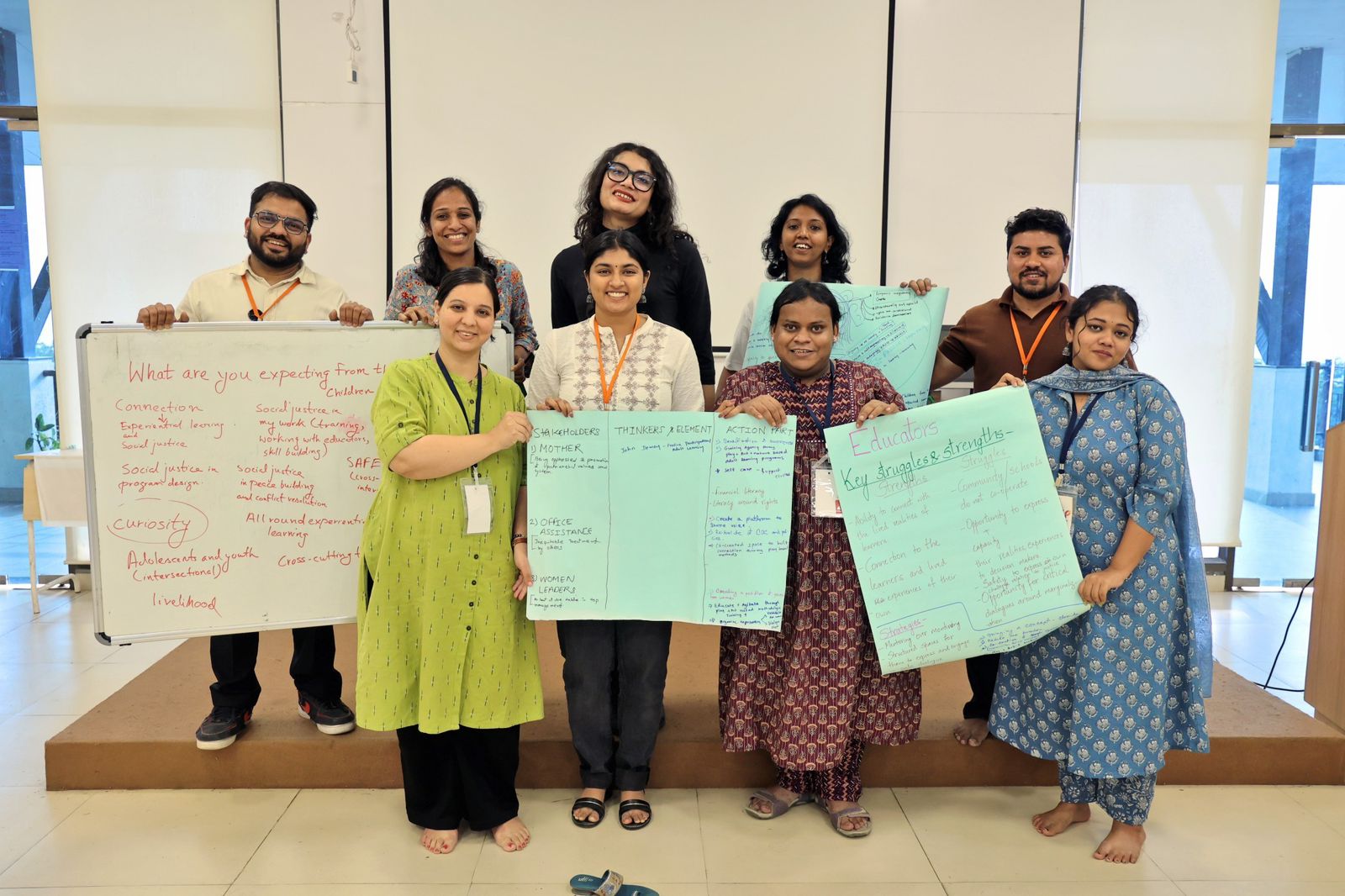
Contribution of Play for Peace®
We offered:
A 180-minute workshop on Play as Resistance
A one-hour open morning Play for Peace session for conference participants
In that open space, participants experienced our methodology — not as theory, but as an embodied process.
They moved.
They laughed.
They reflected.
They connected.
And in that connection, we witnessed what Play for Peace does best:
Build trust across differences.
Learning Across the Conference
FEEB was not only about offering — it was about receiving.
Bridging Experiential Education and Social Justice
Pratyay Malakar (Dr. B.R. Ambedkar University Delhi) facilitated a session that deeply transformed my understanding of social justice.
Her clarity was embodied.
She helped us see that:
Justice is relational and contextual
Justice exists in the emotional realm
Yet emotional awareness must zoom out to see systemic injustice
Educators must be politically conscious — without extremism
Our content, materials, and presence are political
Through the lenses of bell hooks, Paulo Freire, Dr. B.R. Ambedkar, and John Dewey, I began to understand that what we do as educators is never neutral.
It is deeply political.
But it can also be deeply wise.
Pratyay’s words continue to echo:
“Justice is relational… contextual… emotional.
When we connect emotion to systemic awareness — transformation becomes possible.”
Mandala Systems Awareness: Learning from Indonesia
Another powerful learning came from Sahaala and Jasmine from Indonesia.
They shared grounded experiences of implementing the Mandala Systems Awareness Model with children in schools.
Their work illuminated how:
Schools can adopt decolonized models
Holistic systems thinking can be introduced experientially
Children can understand interconnectedness through embodied learning
It was practical. Rooted. Transformative.
Puppetry and Voice Modulation
I also participated in a workshop on Puppetry and Voice Modulation facilitated by Rinti Sengupta — a reminder that creativity and expression are powerful educational tools.
Voice carries the story.
Puppetry carries metaphor.
And both create access points for children to process complex realities safely.
What FEEB Meant for Play for Peace
The FEEB Conference was not an event.
It was a convergence.
A convergence of:
Community
Justice
Experiential wisdom
Decolonized practice
Play as resistance
Intentional facilitation
Representing Play for Peace® in this space reaffirmed something powerful:
A Journey Still Unfolding
Looking back, I see that my journey from meeting Vishwas to standing within FEEB was not accidental.
It was relational.
Intentional.
Communal.
And it continues.
The final gathering of the conference remains close to my heart — standing there as one participant among 200+ practitioners from diverse fields, sharing reflections, learnings, appreciation, and inspiration. There was no hierarchy in that space — only collective gratitude. Listening to voices from different disciplines, geographies, and lived realities reminded me that experiential education is a living movement. The energy in that room was not just professional — it was heartfelt.
We were not just exchanging ideas.
We were strengthening a community.
In that moment, I felt deeply connected — not only as a representative of Play for Peace®, but as a learner among learners. The applause, the shared laughter, the quiet acknowledgments, the words of appreciation — all of it felt like a collective affirmation that this work matters.
With deep gratitude to all who walk this path of experiential education — and to the global Play for Peace community that makes this work possible.
With love and solidarity,
Sinthuja Shanmuganathan
Play for Peace®