
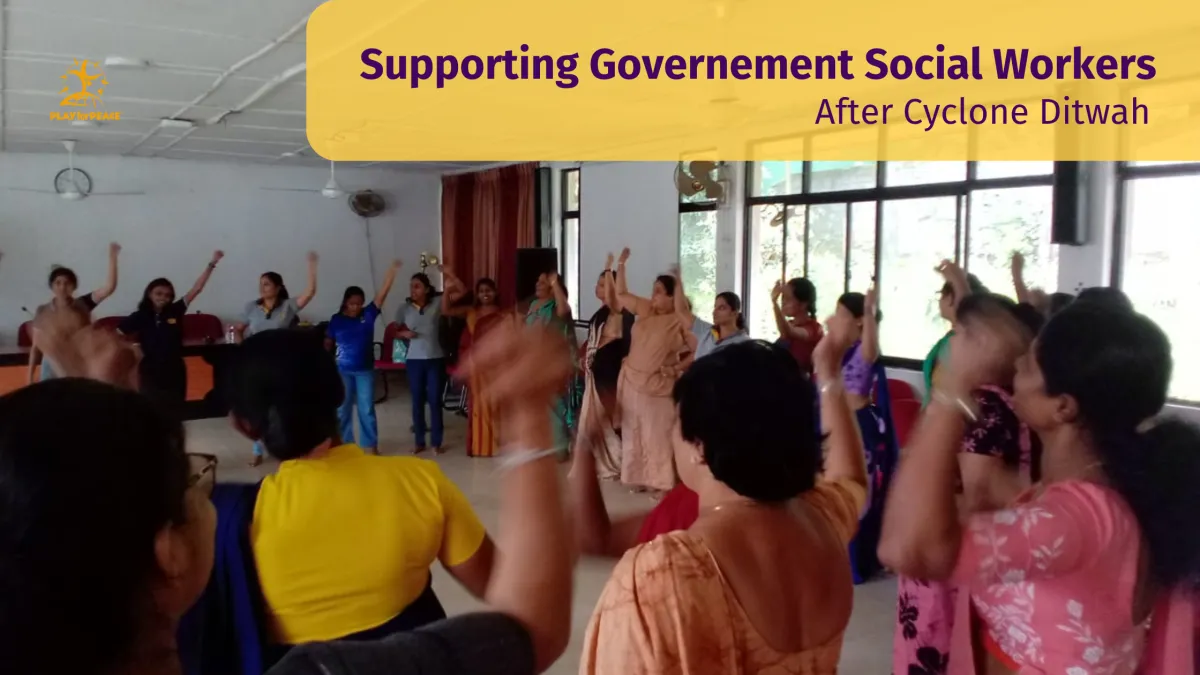
When Play Entered the Divisional Secretariat
Supporting Governement Social Workers After Cyclone Ditwah

In the aftermath of the Ditwah Tropical Cyclone, Play for Peace facilitators and volunteers began working in affected regions to support communities through play-based, relational, and trauma-informed practices. What began as humanitarian relief gradually revealed something deeper: play was not only supporting communities—it was restoring those who serve them.
As facilitators worked alongside local partners, word spread organically about the Play for Peace approach—its ability to create safety, connection, and embodied relief in times of crisis. This led to an invitation from the Divisional Secretariat – Yatinuwara, Embilmeegame (Kandy District) to facilitate a session for government social service officers.
Caring for Those Who Carry Others
The Divisional Secretariat brings together officers responsible for more than 25 thematic areas, including gender, counselling, migrant mothers’ communities, water and sanitation, child protection, and disaster response. In the context of ongoing relief work for Ditwah-affected communities, officials shared a critical concern:
They were experiencing extreme workload, emotional exhaustion, and secondary trauma, with little space to pause, reflect, or recover.
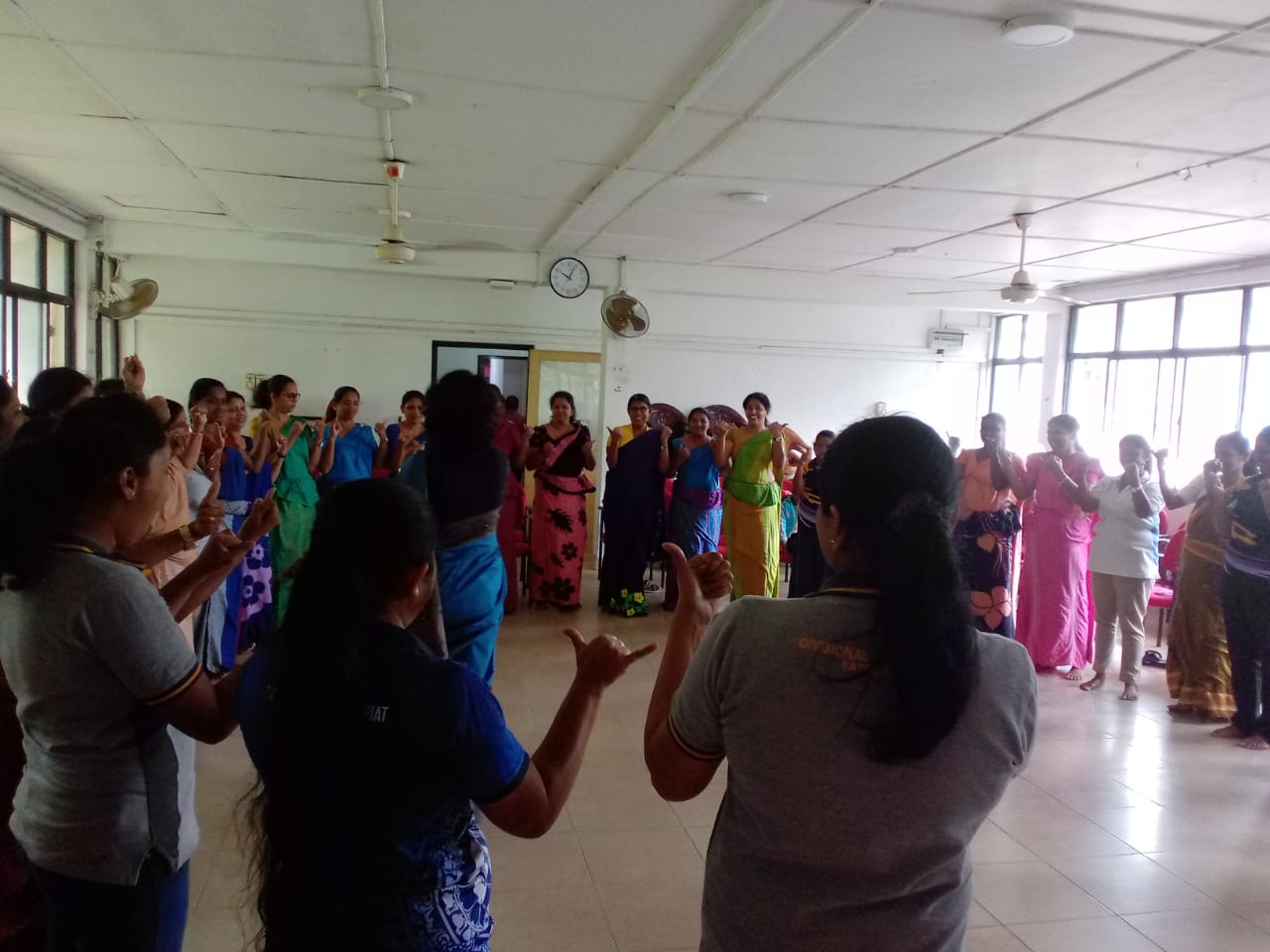
In response, Play for Peace facilitated a three-hour session on self-care and self-compassion, experienced through play. This was not framed as a technical training, but as a relational and embodied space—designed to support the well-being of those who continuously support others.

A Different Kind of Intervention
Through cooperative play, gentle movement, laughter, stillness, and guided reflection, participants were invited to reconnect with their bodies, emotions, and one another. The session intentionally focused on presence rather than productivity, and care rather than correction.
What emerged was striking.
At the close of the session, officers shared written reflections that revealed profound shifts in how they felt, what they remembered, and how they related to themselves and their work.
What Emerged: Voices from the Room
Across 30 written reflections, several themes appeared repeatedly—revealing how play created immediate relief, reconnection, and dignity for officers working under sustained pressure.
Relief and Relaxation
Many participants described deep mental and emotional release:
“Hope this kind of a program in future too. A time we had a mind relaxing feeling.”
“Through this program today, my mind felt relaxation and happy.”
“Today’s program was a very valuable one that relieved the stress in our bodies and minds.”
“A timely effective program for release the stressed we had due to these busy schedules.”
For several officers, this was the first genuine pause they had experienced since the cyclone response began.
Freedom and Presence
Participants spoke about reclaiming time and attention for themselves:
“Felt a feeling of freedom.”
“With only myself I spent the day today. I kept aside my family, job and everything for a moment.”
“Today is a very happy and a well spent day.”
The session created permission to be present—without urgency, responsibility, or performance.
Joy and Reconnection
Play reopened access to joy that had been dormant under stress:
“One happily spent day. Forget about the problems for sometime.”
“A new experience for my life. A beautiful day.”
“Thank you for bringing a little change and a little joy to this tiring life.”
“Thank you for giving me this opportunity to awake the inner child within me.”
Laughter and movement allowed participants to reconnect with parts of themselves often absent in institutional spaces.
Self-Compassion and Dignity
Several reflections named a powerful internal shift—from duty to self-care:
“Madam, you taught me to be empathetic towards myself, to care and love myself.”
“Thank you again for giving me the opportunity to remember me how lovely and respectful am I especially in this job.”
“You taught me to take care of myself, to love myself, and to embrace myself.”
For many, this was the first time self-compassion had been explicitly practiced within their professional environment.
Collective Unity and Empathy
Participants also reflected on shared connection and solidarity:
“So enjoyable as we all were there with unity.”
“We had a chance to spend the day happily and get to know each other.”
“We learned about empathy.”
“My heart was filled with happiness thanks to these effective play activities.”
The session strengthened relational bonds among colleagues working across diverse and demanding social service roles.
A Moment That Captured It All
One reflection captured the collective experience with striking clarity:
“This program, conducted at a time of maximum mental confusion, was like a drop of water falling in a desert.”
Another quietly pointed to the ripple effect beyond the room:
“I teach this to my daughters as well.”
Why This Matters
Disaster response and social service work demand sustained emotional labor that often remains invisible. Without intentional spaces for care, those who support communities are at risk of burnout, emotional withdrawal, and long-term harm.
This session reaffirmed a core Play for Peace belief:
Play is not separate from serious work.
Play is a pathway that sustains serious work—together.
By offering an embodied, relational space for care within a government institution, this initiative highlighted the importance of integrating psychosocial well-being into humanitarian and administrative systems.
Looking Ahead
At the conclusion of the program, officers requested that the session be repeated for colleagues who were unable to attend, noting that over 90 staff members could benefit from similar spaces of care.
What began as post-cyclone relief evolved into something more enduring:
a reminder that peacebuilding includes caring for the caregivers, and that play can open doors—even within formal institutional spaces.