Designing Through Listening: A Decolonial Website Story
Every website asks questions before it shows you anything. Who is this for? Whose way of seeing is built into the navigation? Whose idea of "clear" or "friendly" or "universal" shaped what you find here?
When the opportunity to redesign the Play for Peace® website came to me, I knew those were the questions the project needed to answer. Not just aesthetically. Structurally.
Designing With, Not For
I am a Mexican designer and illustrator, and a Play for Peace® facilitator and co-creator of the club in Mexico. For several years I have watched how international organizations build their narratives, organize their content, and make visual decisions. Many of those practices come from frameworks rooted in the Global North that aim to be universal but do not always reflect the richness of the communities they serve.
From the beginning, Play for Peace® Executive Director Sarah Gough made clear she wanted something different. She wanted a site shaped by a more inclusive, representative perspective, one closer to the diverse realities of the global community Play for Peace® actually lives in. That invitation changed everything about how I approached the work.
Designing for a community is not the same as designing with a community. This project was an attempt to move toward the latter.
Rethinking Every Decision That Usually Goes Unquestioned
The redesign was not just about aesthetics. It meant questioning decisions that are so common they often go unnoticed: navigation logic, language, imagery, symbols. Who decides what counts as intuitive? Whose experience of the web is treated as the default?
One of the central challenges was building a navigation system that did not impose a single route. The goal was to simplify without reducing, to open pathways rather than close them, and to design for users arriving from different cultural contexts, different levels of digital access, and different ways of engaging with technology altogether.
The visual work carried the same intention. As an illustrator, I did not want to rely on generic representations of diversity. The illustrations needed to feel alive and intentional. Different skin tones, cultural expressions, body types, ways of dressing, religious symbols, all coexisting without hierarchy. The colors of the people in the illustrations extend beyond conventional tones. The shapes of the bodies were designed deliberately to suggest connection, figures that visually reach toward one another, evoking relationship and shared presence.
A Map That Questions Its Own Center
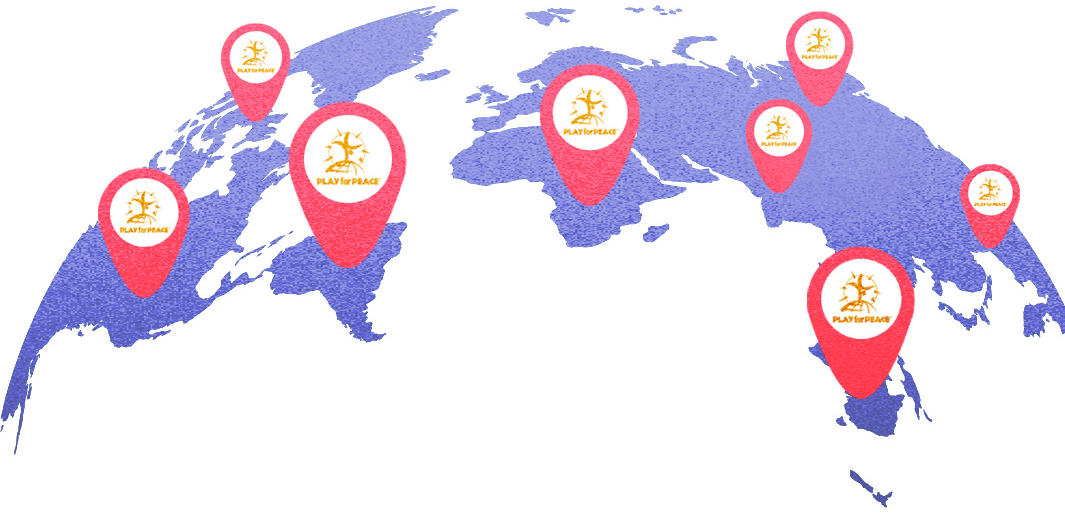
One of the most decisive moments in the process was designing a world map.
Sarah's vision was clear: not a conventional representation, but something shaped by a more decolonial perspective. That meant slowing down. We reviewed different cartographic traditions, questioning their centers, their absences, and what they communicate simply by where they place things. The map now featured on the site is not just a visual resource. It is a conscious attempt to offer another way of seeing territory, one that is more open, more critical, and more honest about the diversity of experiences that inhabit the world.
It does not solve everything. But it signals a direction.
What Trust Makes Possible
Throughout this process, Sarah's willingness to question frameworks that international organizations often take for granted made the project possible. It is not common to find that kind of openness in organizations where processes tend to be more structured and predefined. Her trust made it possible to take risks, to step outside the expected, and to build something that genuinely tries to represent the people who are part of Play for Peace®.
It is worth naming what it means for an organization based in the Global North to take this kind of step. It involves, in some ways, letting go of certain forms of narrative control, and making space for other voices and other ways of seeing. That is not a small thing.
Design Is Never Neutral
What we built is more than a website. It became a conversation shaped as an interface. A space that strives to be more open, more representative, and more honest with the diversity it holds.
Design always communicates a position, even when it does not seem to. And because of that, it can also become a tool to question, to redistribute voices, and to imagine new ways of relating. That is something Play for Peace® has understood from the beginning, and continues to strengthen.
Designing through listening is not easy. But when it happens, even at small scales, it feels different.
Visit the site, explore it, and share your thoughts. Your experience of navigating it is part of understanding the direction this effort has taken.
Inspired by this story? Explore more from our global community at playforpeace.org/stories — or support this work with a gift at playforpeace.org/donate.
Francisco Leon Silva is a Mexican designer, illustrator, and Play for Peace® facilitator. He is the co-creator of the Play for Peace® club in Mexico.