
When Theatre, Play, and Peace Found the Same Language
Applied Theatre School's 20th Anniversary Workshop
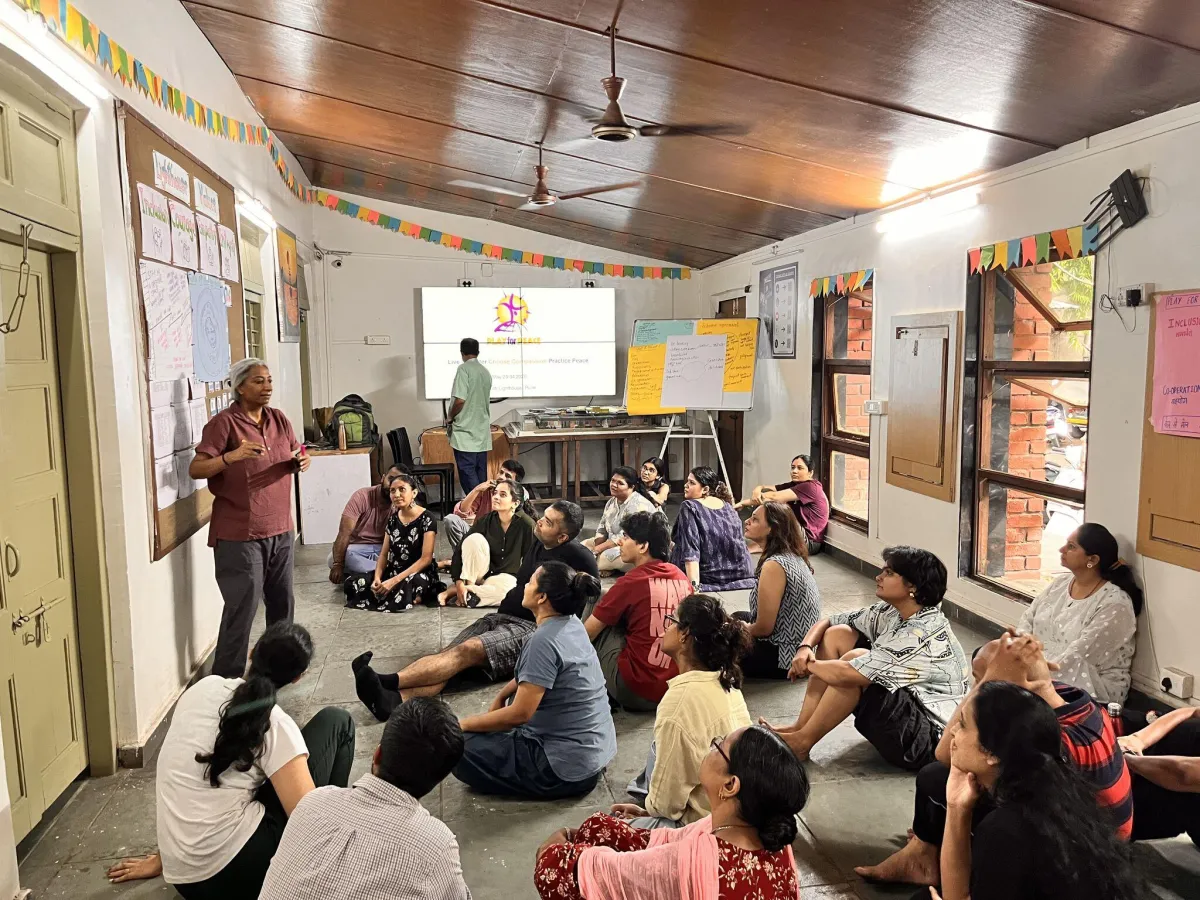
Twenty years ago, Aanand Chabukswar began a body of work rooted in a simple conviction: that theatre is not performance for its own sake, but a tool for education, healing, and awareness. This year, as Applied Theatre School marked that twentieth anniversary, it opened its doors to an open Play for Peace® workshop, and what followed became something none of the organizers quite expected.
The room overflowed. People came from different cities, different countries, different disciplines entirely, drawn in by word of mouth, by conference connections, and by twenty years of friendship between Aanand and his longtime collaborators, Swati Bhatt and Agyat Mitra. Educators sat beside artists. Peacebuilders sat beside travelers. A psychology graduate, a classical dancer, an outdoor facilitator, a social entrepreneur. Nobody quite knew what all the backgrounds in the room were. That was part of the point.
A Rope on the Floor, A Question in the Room
At the center of the two days sat a deceptively simple exercise. Four ropes marked four quadrants on the floor: violence, not violence, acceptable, not acceptable. Facilitators offered a statement, and participants had to choose where they stood.
What emerged surprised many of them. Violence, it turned out, is not only physical. Words can carry it. Silence sometimes does too. The activity did not lecture anyone into this understanding. It simply asked them to stand somewhere and see who stood beside them, and in doing so, it quietly rearranged how an entire room understood harm, safety, and each other.
Three Fields, One Recognition
What made this workshop remarkable was not just the activity itself, but how differently it landed across the people in the room, and how each of them arrived, from their own field, at nearly the same place.
Rashad is an educator and social entrepreneur, founder of The Circuit, and a former Teach For India Fellow in Govandi, Mumbai. For years, he had believed that competition brought out people's best. The workshop unsettled that belief.
"The world does not need more first places, second places, or runners-up," he reflected. "What the world truly needs are more people who can grow together, win together, collaborate, and cooperate." Playfulness, he came to understand, is not an activity. It is a state of being, one that can build trust and inclusion in a classroom far more reliably than competition ever could.
For Aalokini Mili, an Outdoor and Experiential Learning Facilitator, the workshop carried an extra layer of meaning. She had grown up around Swati Bhatt and Agyat Mitra's work in experiential education, watching it quietly shape her for years as a child in the room. This time, she returned not to observe, but to participate consciously, as a facilitator herself, finally understanding the depth behind things she had once only witnessed.
The idea that stayed with her most was connection before content. Before any real learning can happen, she reflected, people need to feel safe, seen, included, and connected. She saw that lesson move through the room in small moments: soft starts that eased people in gently, icebreakers that were never just "time pass" but the beginning of a real journey, and games that became a language for vulnerability where lectures could not reach. She noticed, too, how power sharing between facilitator and participant changed the emotional temperature of a room entirely, down to something as small as a thumbs up standing in for words someone isn't ready to say out loud. Facilitation, she realized, was never about having all the answers. It was about creating spaces where people feel comfortable enough to explore, express, and experience things for themselves.
And Manasi, an Indian classical dance artist, found the workshop's deepest lesson waiting inside her own craft, one she had somehow overlooked. "As practicing artists, ironically we forget that art requires play," she said. "Play enriches art. It was a good reminder of how we achieve the state of flow." For a dancer trained in discipline and precision, the workshop offered something unexpected: permission to return to the playfulness underneath the form.
Where the Fields Meet
Peacebuilder, facilitator, classical dancer. Three people who had spent years perfecting entirely different crafts, arriving in the same room and recognizing, each in their own language, the same thing: that play is not separate from the deep work of healing, teaching, or making art. It is what makes all three possible.
That recognition is, perhaps, the truest marker of Applied Theatre School's twenty years, and of what happens when Play for Peace® meets a room already prepared, by two decades of dedicated work led by Swati Bhatt and Agyat Mitra, to receive it.
As Manasi put it simply, closing her reflection with a wish that carried the whole spirit of the two days:
May the cohort grow.