Why We're Saying We Need Brave
We have been teaching kids the wrong definition of brave.
Brave means fighting. Standing your ground. Never backing down. That is the story American culture tells, in movies, in headlines, and in the way adults talk to children about a world that feels increasingly out of control.
I have spent 27 years in global peacebuilding, working with children and facilitators in 22 countries. Here is what I have come to believe:
“Bravery is the integrity of a choice, not the choice itself.”
Not the choice to fight. Not the choice to stand your ground. Not even, necessarily, the choice to reach across a line someone else drew. What makes something brave is not what you do. It is where the choice came from.
When a child (or a grown-up) is calm in their body, clear in their mind, and able to act in alignment with what actually matters to them, the choice they make is brave. That choice might look like reaching across. It might look like staying back. It might be speaking up. It might be being quiet. It might be a yes. It might be a no. What makes it brave is the integrity. The groundedness underneath it.
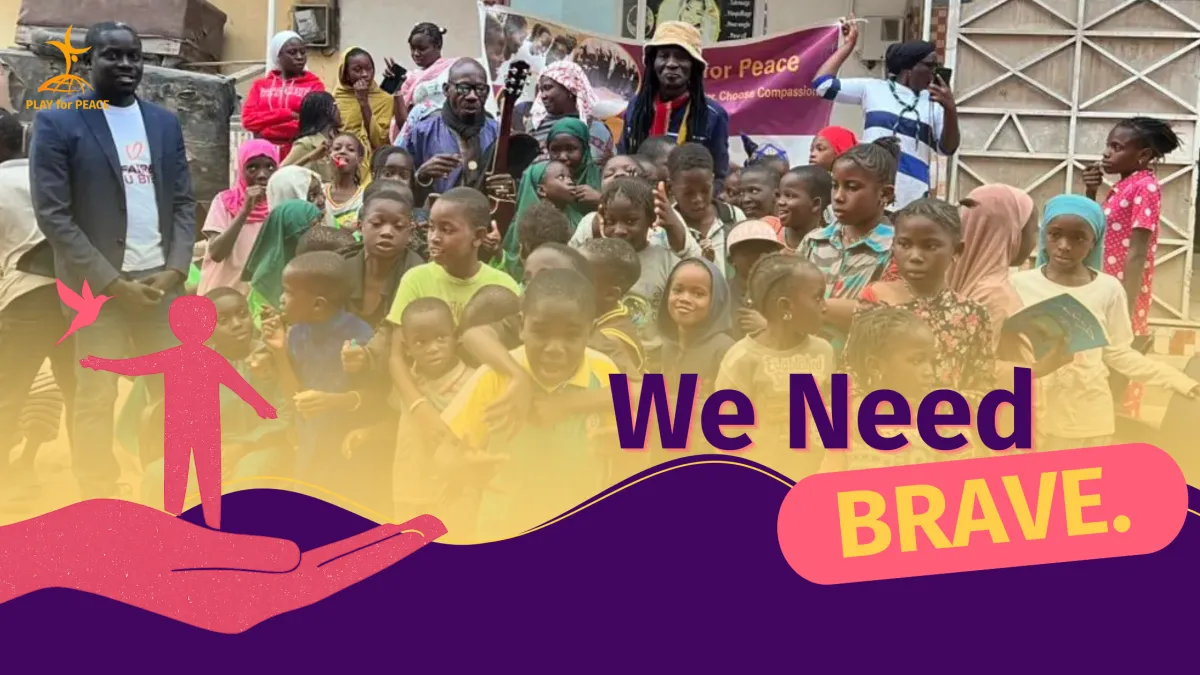
That is what this spring's campaign is about. We Need Brave. An eight-week effort to fund the work at Play for Peace® that builds the capacity for that kind of bravery in children, in the 22 countries where we work.
Why this reframe matters
The old definition of bravery has a cost. Kids who are taught that being brave means fighting or never backing down are being taught, in subtle ways, that their nervous system should not be trusted. That fear is weakness. That staying safe is cowardice. That other people on the “other side” of any line are threats to be overcome.
That definition has been driving global conflict for generations. And children pay for it twice. First when they inherit a world shaped by that kind of bravery. Second when they are asked to perform it themselves.
We want to offer something different. A definition of bravery that honors regulation, clarity, and integrity. That trusts a child's body. That treats discernment as wisdom, not hesitation. That recognizes connection, when it is right to connect, as one of the most courageous things a human being can do.
The three inner moves
Over years of work across countries, we have seen the same thing happen, again and again, when children are given the right conditions. Three inner moves, in order, every time.
First: regulation. A calm body. The nervous system coming back down from alarm. A child who has learned to scan her environment for threat cannot simply decide to relax. Her body has its own logic, and that logic says: stay ready. Play changes that logic. Not through instruction. Through experience. Cooperative games where nobody loses. Where everyone is included. Where the goal is shared instead of contested. Session by session, a child's body gets a different message: you are safe here.
Second: discernment. A clear mind. The capacity to see what is actually in front of you, instead of what fear says is there. Once a child's body is calm, she can look across the room at someone her community told her to fear, and actually see them. Not the story. The person.
Third: connection. An aligned choice. Acting in a way that honors yourself, the people around you, and the world you are building, when and how it is right to do so. Sometimes discernment says yes. Sometimes it says not yet. Both are brave when they come from a grounded, clear place.
That is the work. It is not fast. It is not easy to measure. And it is, as far as we have been able to tell in 27 years of doing it, what actually builds peace.
What we are asking this spring
We are asking Americans to stand behind brave kids. Not to save them. The children we work with are not waiting to be rescued. They are already making choices every day, under conditions most Americans will never have to navigate. Our job, and by extension yours as a supporter, is to fund the capacity that makes those choices possible. A circle. A game. A facilitator trained to create the conditions where a child's body can finally stop bracing long enough to breathe.
That is what your gift does.
And we are asking something else, too. A question we mean.
What is your brave?
Because this campaign is about children, and it is also about all of us. The same inner moves that a child needs in order to live a peaceful life are the moves adults need, too. Regulation in a dysregulated world. Clarity in a moment that wants us to react. Aligned choices, in our families, in our work, in our communities.
So what is your brave? Tell us. Reply to an email, leave a comment, send us a message. We are reading every one.
And if your brave, this spring, is standing behind a child learning what it feels like to belong, we would be honored to put your gift to work.
Stand behind a brave kid. Donate here. →